
Case Details
Client: Confidential Water & Wastewater Treatment Facility
Industry: Water & Wastewater Management / Industrial Instrumentation
Services Delivered: Hardware Design • Firmware Development • Control Algorithm Implementation • System Integration
Technologies Used: MCU-based Electromagnetic Sensing • Faraday’s Law Principles • RS485 & RS232 Communication • 4-20mA / Pulse / Frequency Outputs • Real-time Signal Processing
Let’s Work Together for Development
Call us directly, submit a sample or email us!
Address Business
1. Client Overview
Water and wastewater treatment facilities depend on accurate, continuous flow measurement to manage distribution networks, monitor discharge compliance, and optimise treatment processes. As a general product offering, our Electromagnetic Flow Meter was designed to serve this sector with a robust, MCU-based solution that delivers laboratory-grade precision in a field-deployable, low-maintenance package – covering complete hardware and firmware design in-house.
2. Challenge / Problem
Flow measurement in water and wastewater environments is deceptively demanding. Facilities commonly struggle with several persistent challenges:
Measurement inaccuracy — mechanical flow meters degrade over time due to moving parts, leading to drift and unreliable readings that affect billing, compliance reporting, and process control.
Empty pipe false readings — when pipes run partially empty or drain completely during low-flow periods, conventional meters generate false flow signals, skewing data and triggering false alarms.
Integration complexity — treatment facilities use diverse SCADA and control systems with varying communication standards, making it difficult to connect a single meter across the entire network.
Output inflexibility — different downstream systems — PLCs, data loggers, controllers — require different signal types, forcing facilities to use multiple meter variants or add costly signal converters.
High maintenance overhead — meters with mechanical components require frequent inspection, calibration, and replacement, adding operational cost and downtime in hard-to-access installation points.
3. Solution
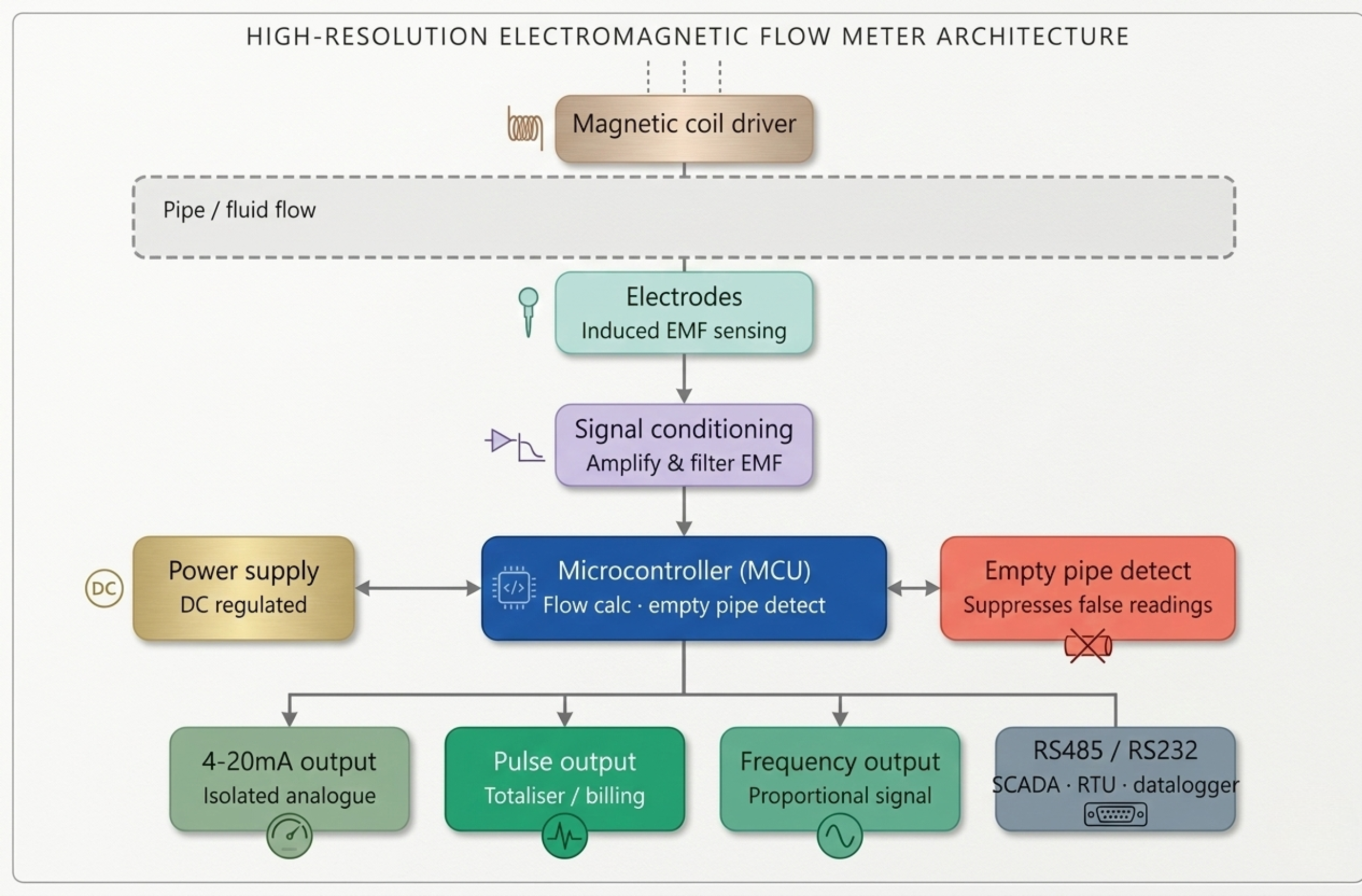
We developed a fully custom Electromagnetic Flow Meter built on an MCU-based architecture, using Faraday’s law of electromagnetic induction to measure liquid flow with no moving parts and no fluid contact on the sensing elements.
Measurement principle The meter induces a controlled magnetic field across the fluid in the pipe. As conductive liquid flows through the field, it generates a voltage proportional to its velocity. The MCU captures and processes this signal with high precision, converting it into accurate volumetric flow readings in real time.
Empty pipe detection An onboard empty pipe detection algorithm continuously monitors the signal integrity of the electromagnetic measurement. When the pipe runs dry or partially empty, the system flags the condition and suppresses false flow readings — ensuring data integrity even during low-demand or drain-down scenarios.
Flexible output types The meter supports three output modes to suit any downstream system: isolated 4-20mA analogue output for direct PLC and controller integration, pulse output for totaliser and billing systems, and frequency output for systems requiring proportional signal scaling. All three can be configured without hardware changes.
Dual communication interfaces RS485 and RS232 interfaces are both built in, enabling the meter to connect directly to SCADA systems, RTUs, and data loggers using standard industrial protocols — without additional converters or interface modules.
No moving parts, minimal maintenance With no mechanical components in the flow path, the meter is immune to wear from particulates and turbulent flow conditions common in wastewater applications. Once installed, it requires no routine mechanical maintenance – only periodic calibration verification.
4. Results & Impact
Outcome | Impact |
High measurement precision | MCU-based electromagnetic sensing delivers stable, drift-free readings unaffected by fluid viscosity, density, or temperature |
Empty pipe detection | Prevents false flow data during pipe drain-down events, improving process reliability and compliance reporting accuracy |
Flexible outputs | 4-20mA, pulse, and frequency outputs eliminate the need for signal converters, simplifying integration with any control architecture |
RS485 / RS232 connectivity | Direct SCADA and RTU integration with no additional interface hardware, reducing installation cost and complexity |
Low maintenance | No moving parts means no wear, no mechanical servicing, and significantly lower lifetime operational cost versus conventional meters |