
Case Details
Client: Confidential Industrial UPS Manufacturer
Industry: Power Electronics / Energy Storage / Industrial UPS Systems
Services Delivered: Hardware Design • Embedded Firmware Development • Battery Health Monitoring System • SCADA/Modbus Integration • UI/UX Interface Development
Technologies Used: MCU-Based BMS Architecture • Cell-Level Voltage/Temperature/Impedance Monitoring • Modbus RTU & TCP/IP • LCD Touchscreen Interface • High-Voltage & High-Current Measurement (Up to 600V / 2000A) • Event Logging System • Industrial Communication Protocols
Let’s Work Together for Development
Call us directly, submit a sample or email us!
Address Business
1. Client Overview
Our client is an industrial UPS system manufacturer seeking to enhance their product offering with intelligent battery health monitoring capabilities. As a manufacturer supplying UPS systems to critical infrastructure facilities, they required a reliable and accurate Battery Management System (BMS) that could monitor individual cell-level health, detect early signs of battery degradation, and provide real-time visibility into the overall battery string status. They approached Aartronix to design and develop a custom BMS tailored to their UPS product line, supporting a wide range of battery types and large multi-string configurations.
2. Challenge / Problem
UPS systems deployed in critical infrastructure environments face serious operational risks when battery health goes unmonitored:
- No visibility into individual cell health — traditional UPS systems only report overall battery voltage, leaving individual cell-level degradation, impedance rise, and temperature anomalies completely invisible until a full battery failure occurs.
- Unexpected battery failures — without continuous monitoring, weakened or failing cells go undetected and cause unexpected UPS failures precisely when backup power is needed most, defeating the core purpose of the UPS system.
- No alarm or early warning system — the absence of real-time alerts meant maintenance teams had no advance warning of developing faults, forcing them into reactive replacements rather than planned maintenance.
- High battery replacement costs — without the ability to identify which specific cells were degraded, maintenance teams were forced to replace entire battery strings rather than individual faulty cells, driving up replacement costs significantly.
- Manual monitoring with no remote access — periodic manual inspections are impractical for UPS systems deployed across multiple sites, making it impossible to maintain consistent oversight of battery health across an entire installation fleet.
The client needed a single integrated BMS solution that addressed all of these challenges within their UPS product line.
3. Solution
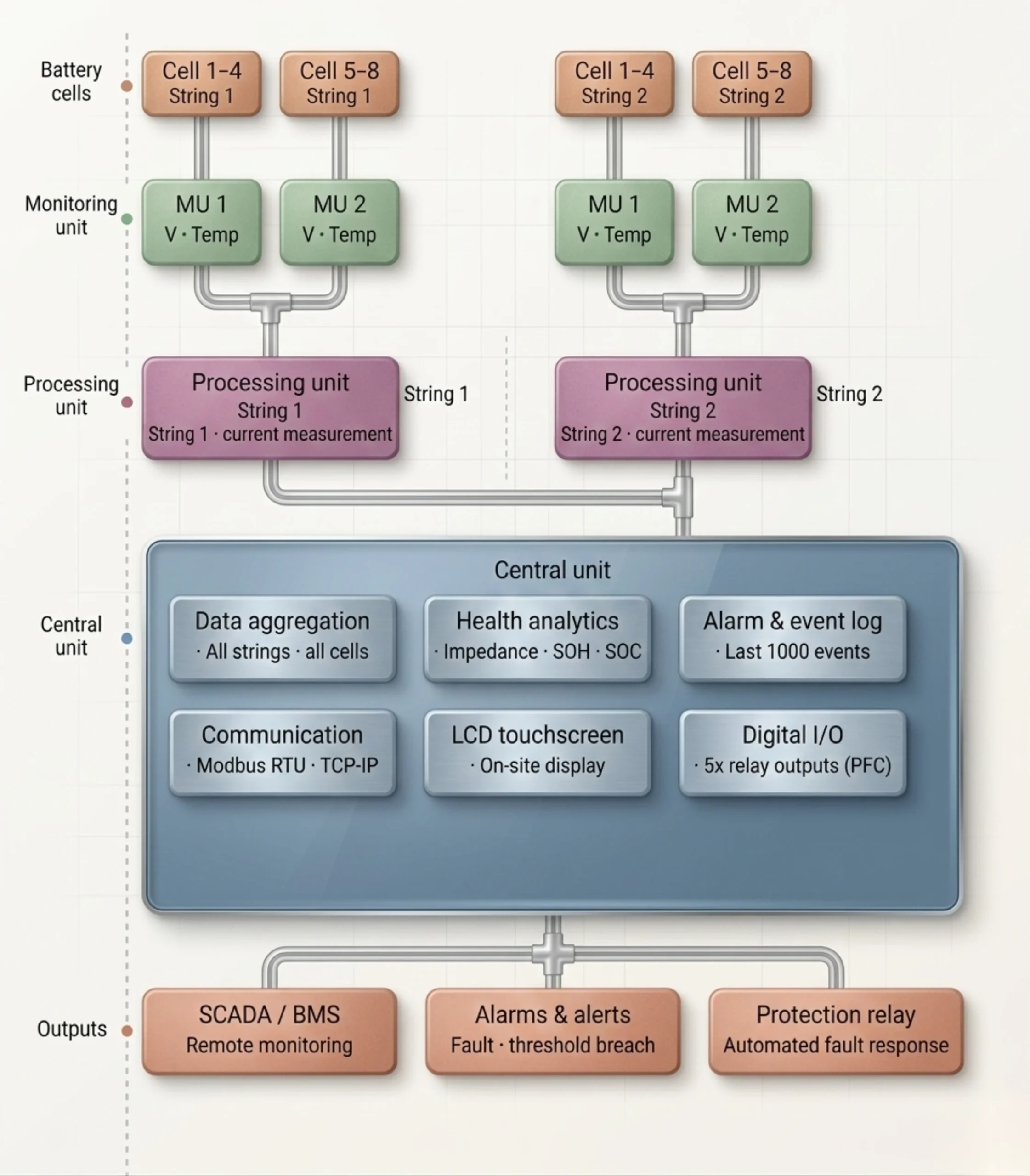
Aartronix designed and developed a custom Battery Management System with comprehensive cell-level and string-level monitoring, built specifically for integration into the client’s industrial UPS systems.
Wide-Range Battery Monitoring: The BMS supports string voltages up to 600 V and string currents up to 2000 A, making it suitable for large-scale industrial UPS configurations. It monitors up to 400 individual cells across up to 4 battery strings simultaneously, covering 1.2 V, 2 V, and 12 V cell types within a single unified platform.
Cell-Level Health Monitoring: At the heart of the system is granular per-cell monitoring of voltage, temperature, and impedance — the three key indicators of cell health and degradation. Impedance measurement in particular enables early detection of aging cells well before they cause a system-level fault.
String-Level Monitoring: At the string level, the BMS continuously tracks voltage and current across all 4 strings, providing a complete picture of the overall battery bank status alongside the cell-level detail.
High Accuracy Measurement: All measurements are delivered at ±0.5% accuracy, ensuring that subtle degradation trends are captured reliably rather than being masked by measurement noise.
Alarm and Event Logging: The system maintains a log of the last 1000 alarm and event records, giving maintenance engineers a full historical trace of battery behavior to support root cause analysis and long-term health trending.
Operator Interface: An onboard LCD touchscreen display gives on-site technicians direct access to real-time battery status, alarm history, and system diagnostics without requiring a separate device or remote connection.
Digital I/O and Protection: A minimum of 5 digital inputs and relay outputs (PFC) enable integration with external protection systems and allow the BMS to trigger automated responses to critical fault conditions.
Connectivity: Modbus RTU and Modbus TCP-IP communication ports allow seamless integration with the client’s existing SCADA systems, building management systems, and remote monitoring platforms.
Environmental Robustness: The system operates across a temperature range of 0–55°C with 95% non-condensing humidity tolerance, suitable for deployment in battery rooms and industrial environments. Battery cell to sensor cabling is supported up to 25 metres, providing installation flexibility across large battery room layouts.
Safety and Compliance: The BMS carries UL, CE, and RoHS certification, meeting the safety and regulatory requirements for industrial UPS applications across international markets.
4. Results & Impact
The integration of Aartronix’s BMS into the client’s UPS product line delivered measurable improvements across reliability, maintenance efficiency, and product competitiveness:
Outcome | Impact |
Early fault detection | Per-cell voltage, temperature, and impedance monitoring enabled identification of degrading cells weeks before they could cause a system-level UPS failure, significantly improving backup power reliability. |
Reduced battery replacement costs | Precise cell-level fault isolation allowed maintenance teams to replace only the specific failed cells rather than entire strings, substantially lowering battery maintenance expenditure. |
Remote monitoring capability | Modbus TCP-IP connectivity enabled integration with remote monitoring platforms, giving operators full visibility into battery health across all deployed UPS sites without requiring physical site visits. |
Proactive maintenance | The 1000-event alarm log and real-time alerts allowed maintenance teams to shift from reactive emergency replacements to planned, scheduled interventions. |
Broader product compatibility | Support for 1.2 V, 2 V, and 12 V cell types across up to 400 cells and 4 strings gave the client a single BMS platform deployable across their entire UPS product range. |
Market readiness | UL, CE, and RoHS certification enabled the client to deploy BMS-equipped UPS systems across international markets without additional compliance engineering. |